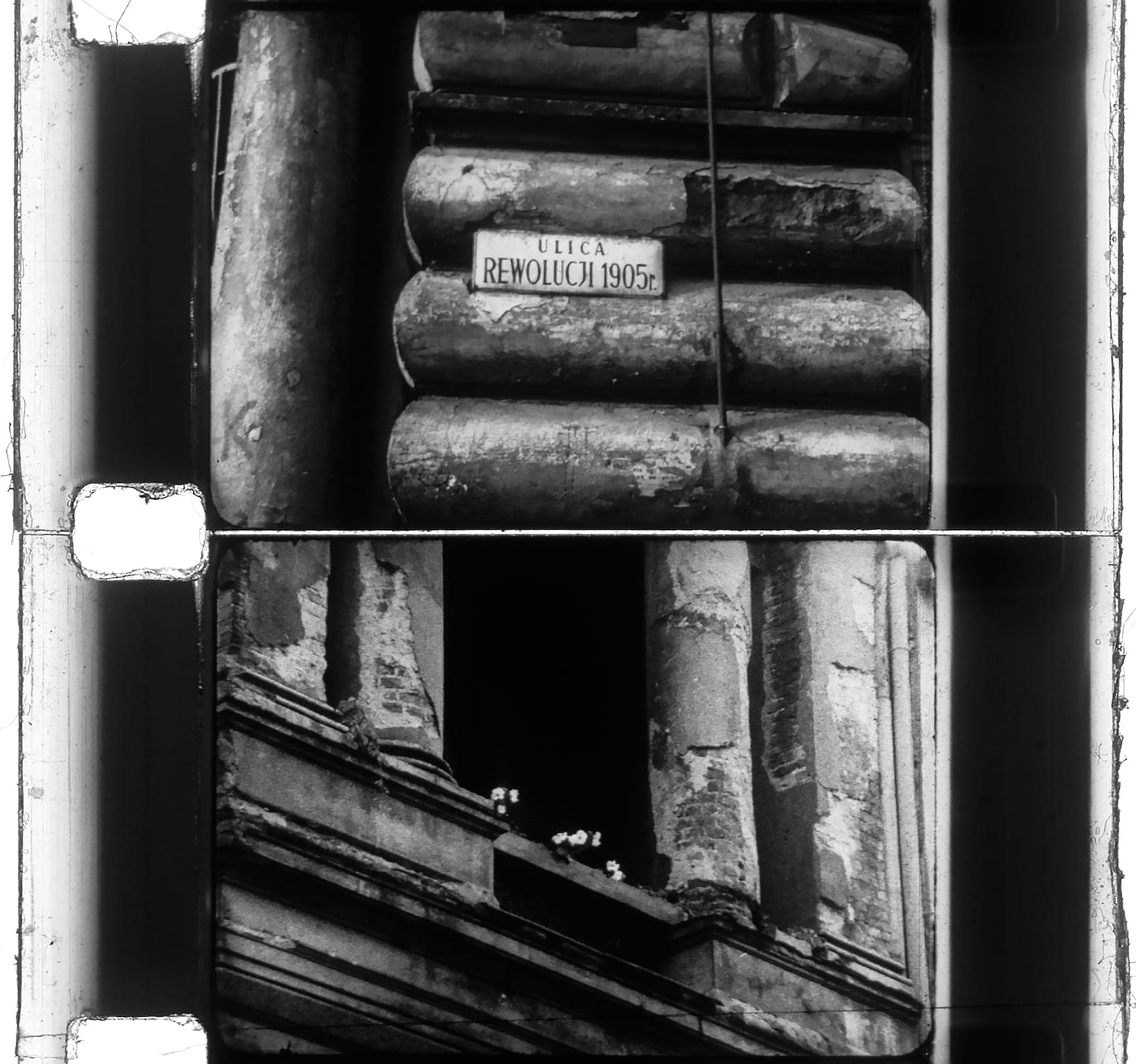
"Images of a vanishing world—the nineteenth-century manufacturing city of Łódź in Poland—are rendered with devotion by Hutton. As he wanders a ghostly city trammeled by history's cruel progress, Hutton finds poetry in its empty cobblestone streets, its crumbling stone facades blackened with soot and atlantes heavy with burden, its cemetery overflowing with the toppled gravestones of Jews, and its dying traditions: the proud guild of chimney sweeps, recognizable by their shiny brass buttons; and the textile looms with their beautiful mechanized movements." — MoMA
"[Lodz Symphony] continues the series of exquisitely understated and beautifully photographed city portraits that Hutton has completed… Hutton's title is meant to relate the film to the influential 'city symphonies' of the 1920s, such as Walter Ruttmann's Berlin: Symphony of a Great City and Dziga Vertov's Man with a Movie Camera. Where Vertov and Ruttmann celebrated hectic urban vitality with assertive modernist montage, in Lodz Symphony Hutton has opted for a slower paced, reflective look at a decaying industrial city haunted by a tragic political past. Lodz's sparsely populated streets and empty textile mills bear the burden of the Holocaust and the forty years of disastrous economic policies under the domination of the Soviet Union. But the unmistakably darker implications of the film are mitigated and thus made more multidimensional by Hutton's classic, Lumiere-like camera style. With a straightforward and well-schooled command of light and composition, Hutton wrests an enduring, nostalgic beauty from the vestiges of former glory in this drab place." — John Pruitt
Łódź Symphony (1991-1993)